Celestial City
Little WomenCelestial City is the destination that gives the March family’s ordinary struggles a larger moral and spiritual shape. Introduced through the sisters’ childhood reenactment of The Pilgrim's Progress, it becomes more than a make-believe place: it names the peace toward which their burdens, duties, mistakes, faith, and grief are directed. Its meaning deepens from a child’s reward at the end of a game into an image of religious hope, especially when the family confronts illness, separation, doubt, and death.
Origin in Childhood Play
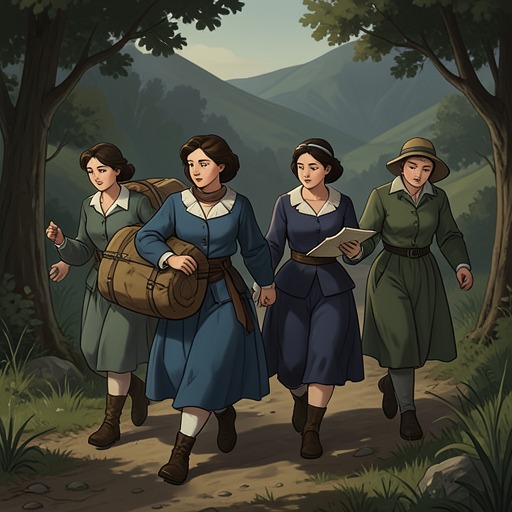
Mrs. March recalls how the girls once played pilgrims throughout the house. Their piece bags became burdens, their hats and sticks the equipment of travelers, and the rooms of their home were transformed into stages of the journey: the cellar represented the City of Destruction, while the housetop became the Celestial City, filled with the lovely things the children gathered there. The game gave domestic space a moral geography and allowed the sisters to experience hardship, danger, and reward through movement from one level of the house to another.
The sisters remember different parts of this imaginary pilgrimage according to their temperaments. Josephine March recalls passing the lions, fighting Apollyon, and crossing the valley inhabited by hobgoblins. Margaret March remembers the moment when burdens fell away and tumbled downstairs. Amy Curtis March remembers the frightening cellar and dark entry more vividly than the journey itself, while preferring the cake and milk waiting at the top. These contrasting memories make the Celestial City both a shared family tradition and a personal image, shaped by each sister’s fears, desires, and understanding of consolation.
A Moral Destination
Mrs. March insists that the pilgrimage is not merely a childish performance. The burdens are present in the girls’ actual lives, the road lies before them, and the longing for goodness and happiness guides them through troubles and mistakes toward a peace figured as the Celestial City. The metaphor therefore converts everyday discipline into purposeful movement. Work, self-denial, patience, and the effort to overcome one’s faults are not isolated acts; they are steps along a road whose destination is moral and spiritual fulfillment.
This teaching immediately connects the image to the sisters’ acknowledged burdens. Josephine March resolves to become what her father calls a “little woman,” restraining her roughness and wildness and doing her duty at home rather than longing to be elsewhere. Elizabeth March responds to the family’s uncertainty through quiet work, knitting an army sock while resolving to become the daughter her father hopes to find when he returns. The Celestial City thus provides a common destination without erasing individual struggle: each sister must carry a different burden and practice a different form of self-command.
The same framework governs Mrs. March’s counsel when she leaves the girls during the family crisis. She tells them not to become idle in sorrow but to continue their work, because work is a blessed solace, and she urges them to maintain hope and activity whatever happens. Her instruction turns the pilgrimage image into a practical household ethic. The road toward the Celestial City is not escape from responsibility; it is the faithful performance of responsibility under painful conditions.
Landscape and Imagination
The image later moves outdoors, where the March sisters and Theodore Laurence continue to play pilgrims on a hill they call the Delectable Mountain. They bring their work in bags, wear old hats, use poles to climb the hill, and look outward toward a country where they hope to live someday. The game has grown with them: it remains playful, but it now carries explicit aspirations, linking the sisters’ present labor with imagined futures beyond the limits of their current home.
From the hill, the view gives the Celestial City an almost visionary form. Across the wide blue river lie meadows, the outskirts of the great city, and green hills rising toward the sky. In the autumn sunset, gold and purple clouds gather above the hilltops, while silvery peaks shine in the ruddy light like airy spires of a Celestial City. Theodore Laurence responds to the beauty of the scene, while Amy Curtis March wishes she could paint it. The landscape does not simply illustrate the metaphor; it shows how the family’s imaginative practice teaches them to perceive ordinary nature as a promise of a larger beauty.
Religious Hope and Death
The Celestial City is also connected to the family’s religious understanding of suffering. Margaret March’s Christmas book is a copy of the story of the best life ever lived, which Josephine March recognizes as a true guidebook for a pilgrim undertaking a long journey. Their mother’s small books, each differently colored and made precious by her words, place the pilgrimage within a devotional practice. The destination is therefore not only a literary image borrowed from The Pilgrim's Progress but part of the sisters’ formation through reading, family instruction, and faith.
Mrs. March explains that reliance on the Heavenly Father offers a strength more enduring than human power and wisdom. His love and care, she teaches, do not tire, change, or disappear, and may become the source of lifelong peace, happiness, and strength. This belief gives the Celestial City its ultimate theological horizon. The imagined destination does not promise that earthly troubles will be prevented; it promises that they can be endured within a larger order of love, trust, and hope.
Music provides another route toward that consolation. When the family prepares for the father’s return after his illness, Elizabeth March plays his favorite hymn. The others begin bravely but gradually fall silent, leaving Elizabeth alone to sing with all her heart because music is her sweet consoler. The scene joins devotional sound to the pilgrimage motif: when speech fails under grief, a religious song continues the movement toward comfort.
Elizabeth March’s death gives the image its most solemn fulfillment. As Father and Mother guide her through the Valley of the Shadow and give her up to God, the language of pilgrimage moves from metaphor into the final passage of her life. She dies quietly before dawn, with only one loving look and a little sigh, and the family sees a peaceful serenity replace the patience that suffering had demanded. Morning brings an extinguished fire, an empty place where Josephine March had sat, birdsong, snowdrops, and spring sunshine falling over Elizabeth March’s peaceful face. The Celestial City is not represented as a visible location reached in a spectacular vision; it is the promised peace that allows the survivors to understand her death as an arrival rather than only a loss.
Narrative Significance
The Celestial City organizes the novel’s recurring contrast between burdens and hopes, confinement and possibility, childish play and adult seriousness. It first makes the home into a miniature moral universe, then turns a hillside landscape into a threshold of aspiration, and finally frames illness and death within a faith in continued peace. Its recurrence gives the March sisters’ development a shared structure even though their paths diverge.
The image also shapes the novel’s treatment of character. Josephine March’s struggles with temper, ambition, and self-control, Elizabeth March’s devotion to quiet duty and music, and the family’s insistence on work during grief all become forms of pilgrimage. Even intellectual conflict is measured against the same spiritual ground: when Friedrich Bhaer defends religion against speculative disbelief, Josephine March feels that the world has become right again and that faith is solid ground rather than an empty fable. The Celestial City consequently stands for a destination where truth, reverence, good will, love, and endurance are reconciled—a place imagined beyond ordinary life, but approached through the concrete duties of home.